
Nowadays, poly-wrapping represents a common, practical and cost-effective method of processing packaging and mailing applications. Virtually all of the multifarious products of the printing and graphic arts industry – magazines, newspapers, books, brochures, agendas, directories, calendars, etc. – can be poly-wrapped.
Poly (or film) wrapping makes it possible to bundle different kinds of items into individual packages that can be mailed conveniently to customers. This eliminates having to send multiple mail pieces to the same recipient. Poly-wrapped packages are attractive and provide a high level of protection. Poly-wrapping applications can be customized to meet a variety of needs, such as storage, display and mailing.
Kern 40 product line
The Kern 40 Poly Wrapping Series is a complete line of machines specially developed and designed to respond effectively to the demands of the wrapping market. Four different models of the Kern 40 are available. Each model combines a different set of features to address a specific spectrum of needs.
Principle features of the Kern 40
Kern 40 Poly Wrapping Systems are designed and built for optimum throughput and ergonomic operation. Not only does the Kern 40’s modularity make it possible to configure each system to handle certain types of applications.
This characteristic also allows you to upgrade a system in the field at any time – a factor which helps to safeguard your initial investment. The user-friendly touch-screen operating panel enables the quick set-up of job parameters, fast changeovers, and streamlined procedures. Applications and corresponding parameters are memorized by the system. The electronic control unit of the Kern 40 ensures the precise and accurate setting of parameters, simplifies adjustment, and facilitates operation of the system.
The number of moving mechanical components has been reduced to a minimum, resulting in less wear and tear, and decreased maintenance costs. Product Feeding Modules The Kern 40’s collating section can be equipped with two different types of feeders: fixed and mobile. Fixed feeders are mounted directly on the collating section of a system. Mobile feeders are placed on supports that can easily be connected to and removed from the collating section.
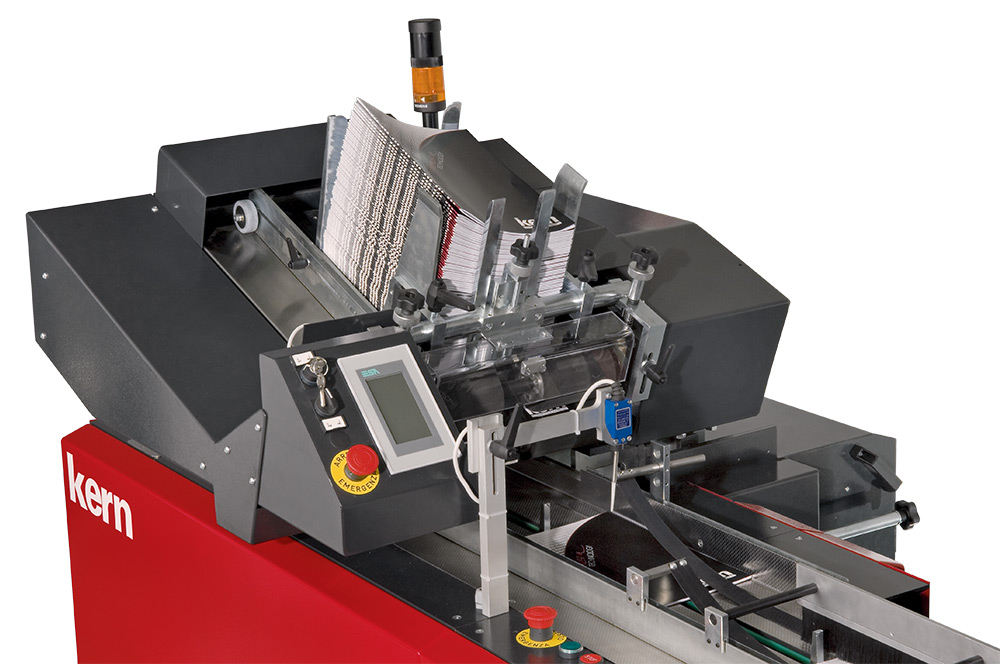
The full range of feeders is available for both fixed and mobile installation. Mobile Feeders Mobile feeders are equipped with an independent electronic management and motion system. They are installed on mobile supports and can be attached at any available position along the collating section. Depending on the application being run, the operator is able to configure the system in a variety of ways. Shuttle Feeder Automatic shuttle feeder for magazines, paperbacks, books, etc.
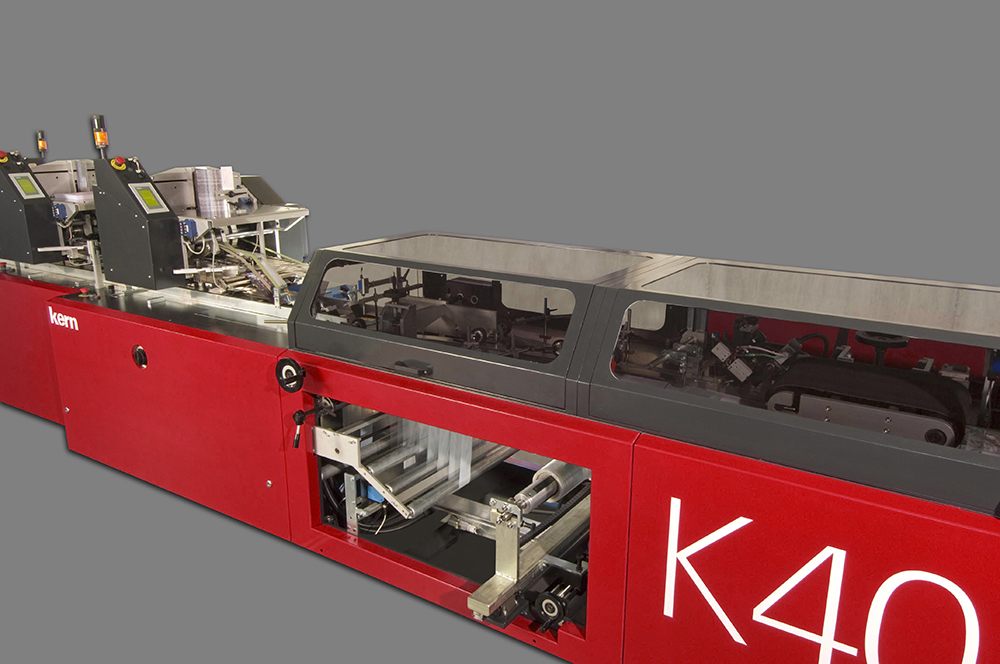
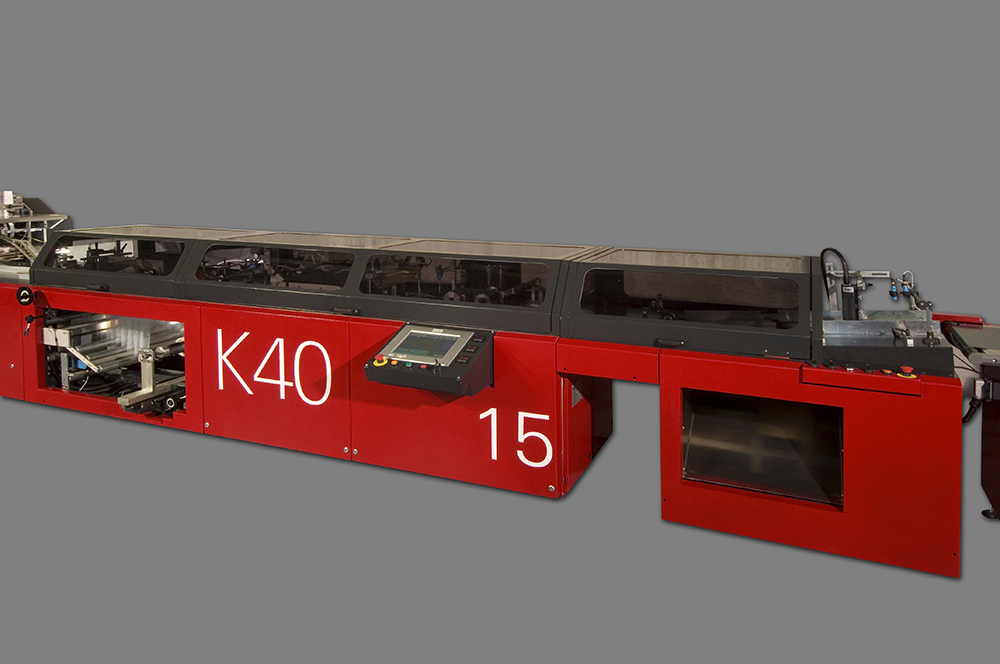
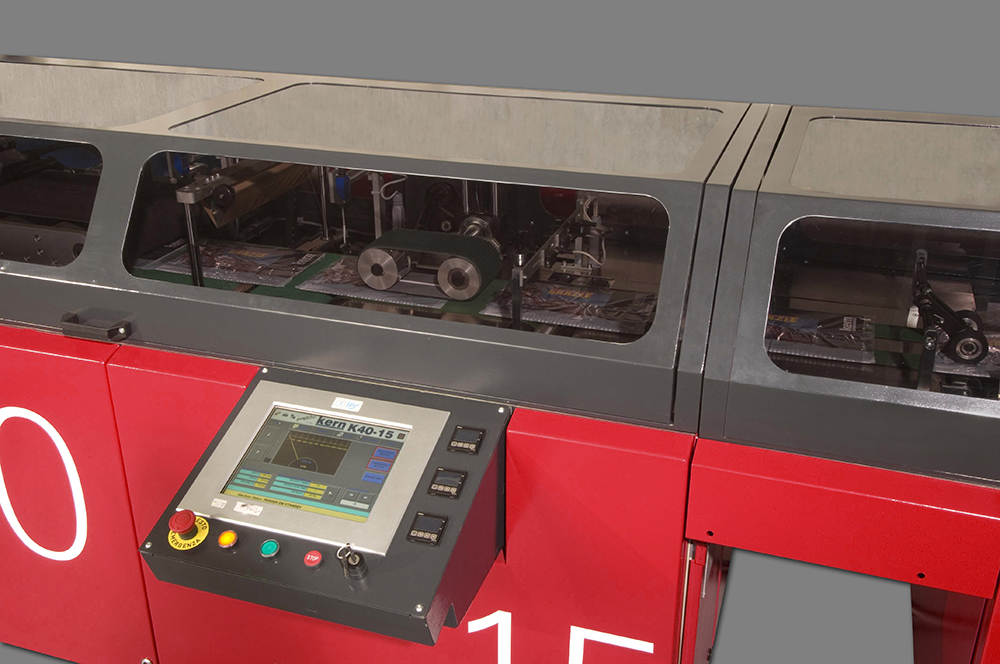
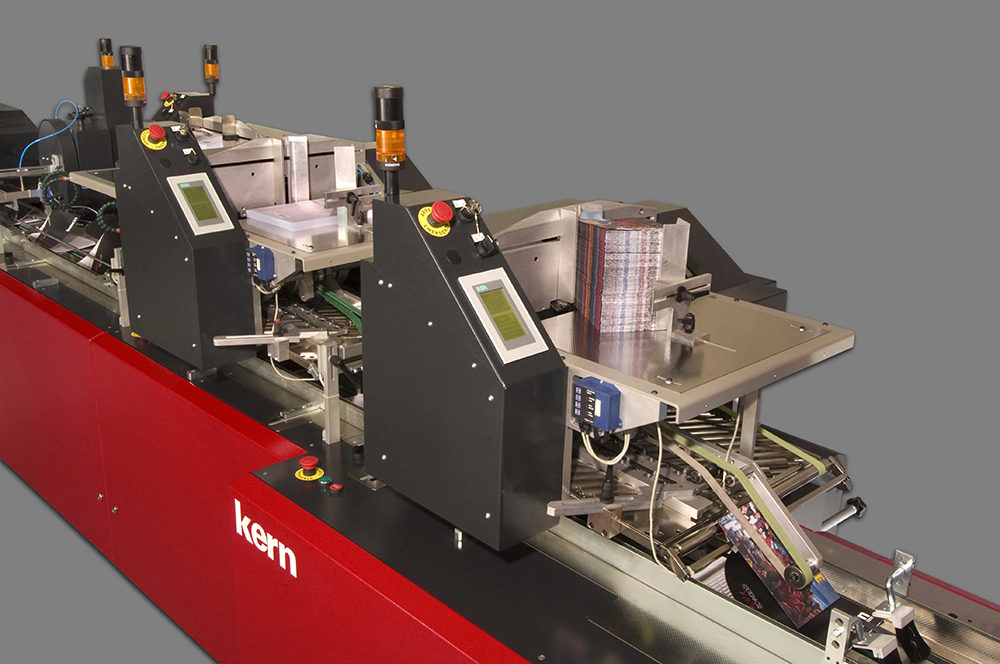

Kern 40-15
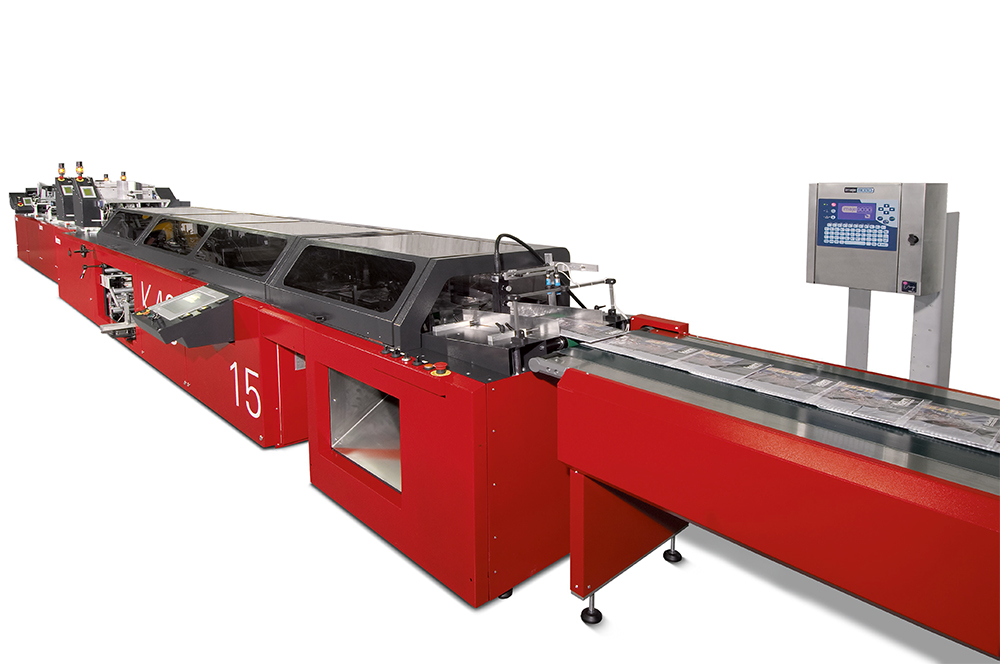
The K40-15 is a wrapping system developed primarily to handle mailing applications. Generally, the system is utilised to poly-wrap and dispatch bulk quantities of magazines, leaflets, and other publishing products. The K40-15 is extremely flexible and is designed for rapid changeovers. The system is capable of collating with great efficiency products of various types and dimensions. When evaluating the advantages of the K40-15, it is important to take into account not only the cycling speed but also the high throughput of the entire system.
| mm | inches | |
| Min. product size | 120 x 150 | 4.7 x 5.9 |
| Max. product size | 300 x 420 | 11.8 x 16.5 |
| Min. product thickness | 0.1 | |
| Max. product thickness | 40 | 1.57 |
| Max. roll diameter (internal unwinder) | 400 | 15.7 |
| Max. roll diameter (external unwinder) | 600 | 23.6 |
| Max. film width | 700 | 27.5 |
| Max. cycling speed: | 15,000 pieces per hour | |
| Types of film: | polyethylene, polypropylene, PVC | |
Kern 40-9
The K40-9 is a wrapping machine designed to wrap thick bundles containing products such as books, directories, and groups of catalogues or magazines. Innovative, state-of-the-art electronics, combined with a special transversal sealing module, make it possible to manage thick products efficiently and to separate wrapped items rapidly and accurately, with few interventions by the operator.
| mm | inches | |
| Min. product size | 120 x 150 | 4.7 x 5.9 |
| Max. product size | 300 x 420 | 11.8 x 16.5 |
| Min. product thickness | 0.1 | |
| Max. product thickness | 80 | 3.14 |
| Max. roll diameter (internal unwinder) | 400 | 15.7 |
| Max. roll diameter (external unwinder) | 600 | 23.6 |
| Max. film width | 700 | 27.5 |
| Max. cycling speed: | 9000 pieces per hour | |
| Types of film: | polyethylene, polypropylene, PVC | |
Kern 40-6
The K40-6 represents the entry-level machine of the series. It provides a cost-effective solution for wrapping magazines, books, and publishing and commercial products, in general. Hence, it targets companies which demand excellent output quality but do not require high speed. Despite being an entry-level machine, the K40-6 is equipped with a complete electronic control system. Thus, various product formats and the processing of jobs can be managed just as easily on a K40-6 as on other Kern 40 models. The K40-6 may also be used as a low-cost back up or to process secondary jobs.
| mm | inches | |
| Min. product size | 120 x 150 | 4.7 x 5.9 |
| Max. product size | 300 x 420 | 11.8 x 16.5 |
| Min. product thickness | 0.1 | |
| Max. product thickness | 40 | 1.57 |
| Max. roll diameter (internal unwinder) | 400 | 15.7 |
| Max. film width | 700 | 27.5 |
| Max. cycling speed: | 6000 pieces per hour | |
| Types of film: | polyethylene, polypropylene, PVC | |
Only fixed feeders are available.
Kern 40-1
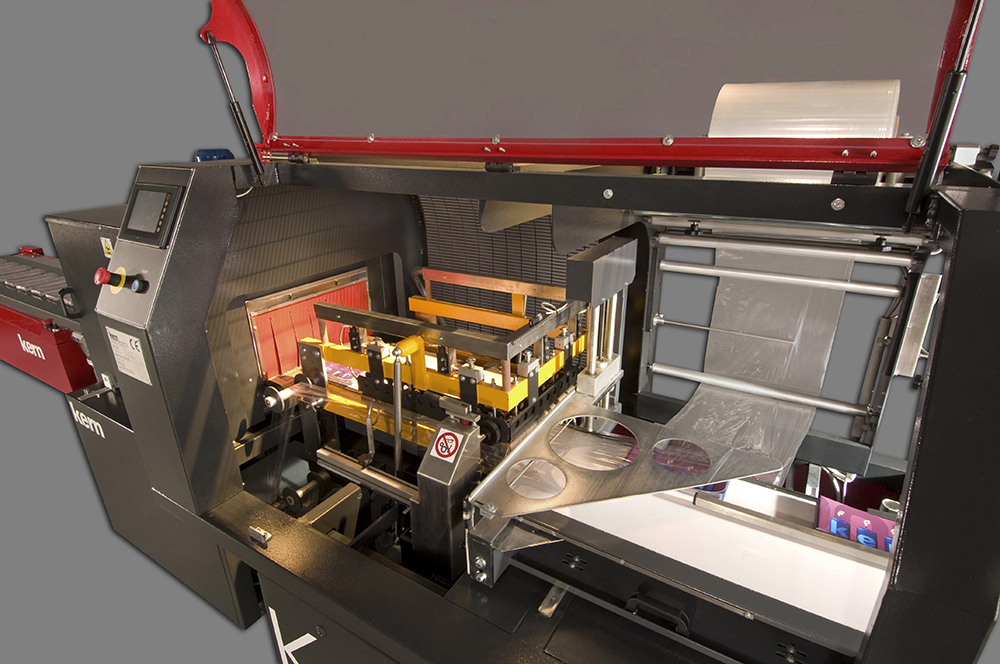
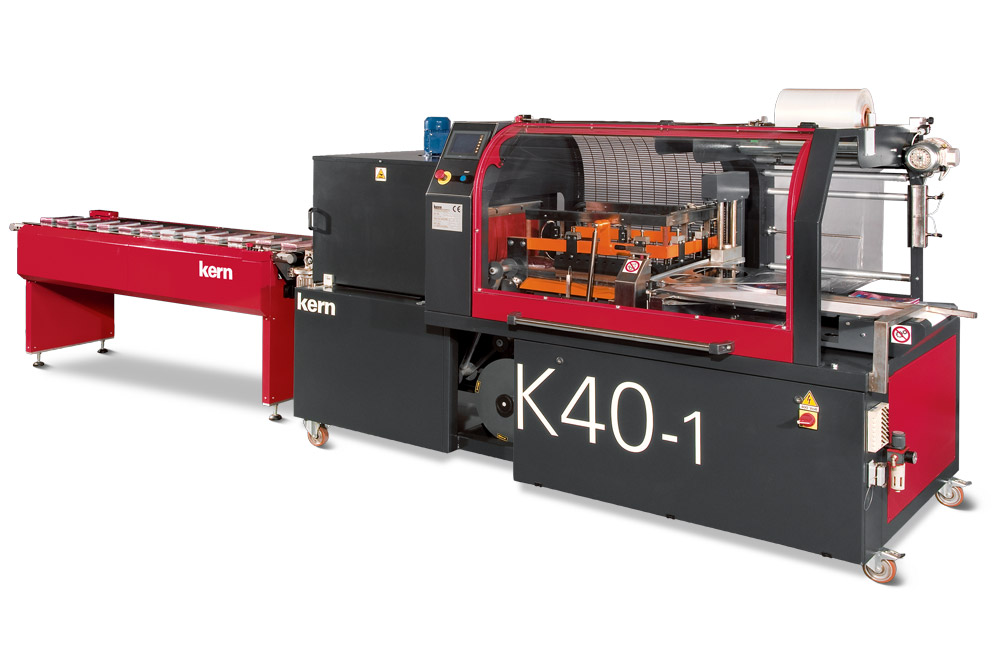
The K40-1 processes folded film. Packages are sealed by means of an L-shaped sealing device. The K40-1 is an entry-level poly wrapper that can be used to wrap individual books, stacks of publications, and packages. The system is equipped with a shrinking tunnel. It can operate independently, or serve as the end module of a bindery line.
| mm | inches | |
| Min. product size | 100 x 150 | 3.9 x 5.9 |
| Max. product size | 300 x 420 | 11.8 x 16.5 |
| Min. product thickness | 5 | 0.2 |
| Max. product thickness | 150 | 5.9 |
| Max. roll diameter (internal unwinder) | 300 | 11.8 |
| Max. width of folded film | 500 | 19.7 |
| Max. cycling speed: | 1200 pieces per hour | |
| Types of film: | polyethylene, polypropylene, PVC | |
Our Services
- Personal advisory service on-site
- System integration
- Requirement analysis
- Work out an ideal solution
- On-site training of your employees
- Comprehensive support during operational phase